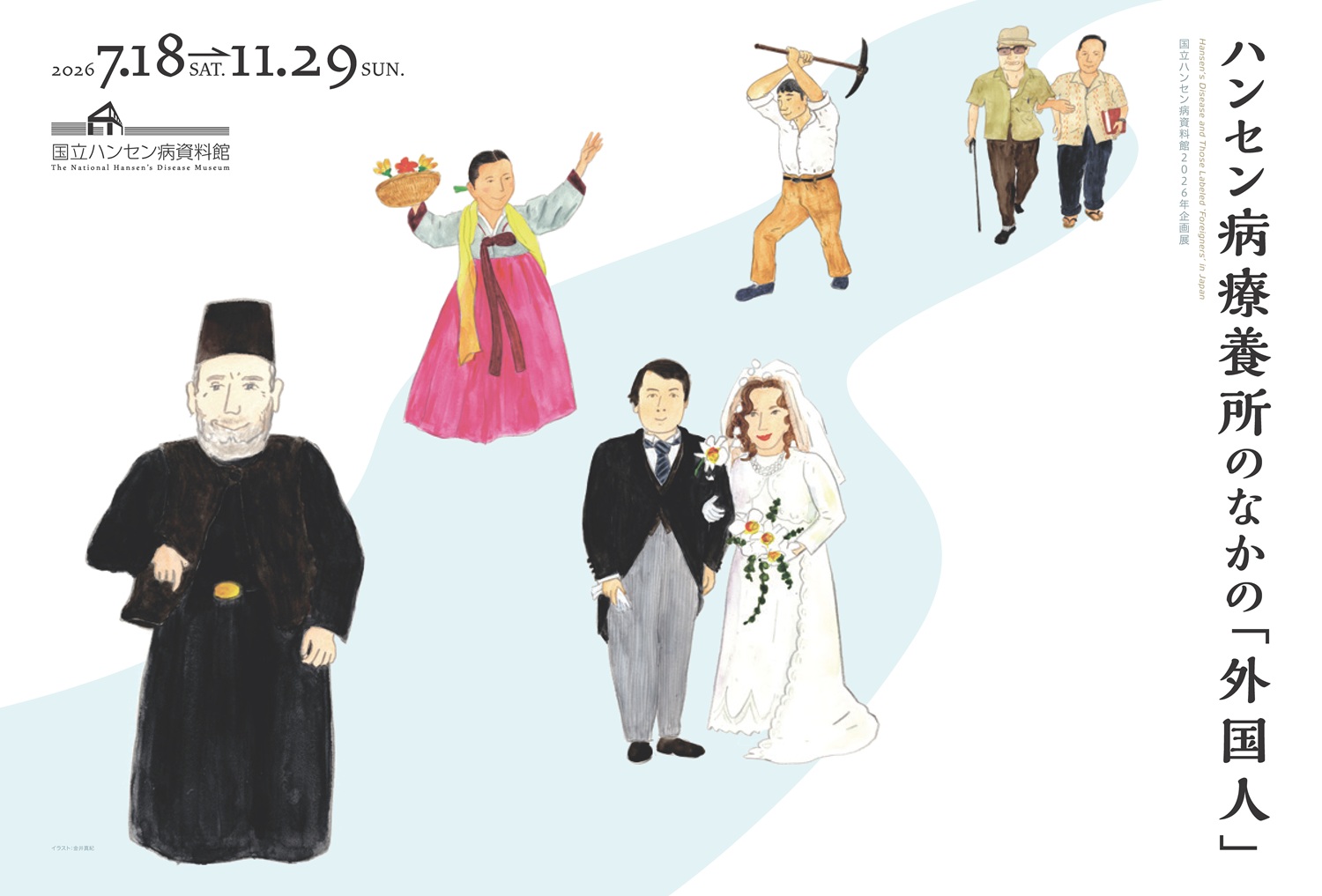
This exhibition sheds light on people of foreign origin who resided in Leprosy sanatorium.
This exhibition focuses particularly on materials related to the large number of Korean residents in Japan*. It organizes materials by theme, including tools used in arduous construction work, records of the struggle for pensions since 1959, depictions of their lives as they tried to preserve their ethnic identity, ethnic dance costumes and instruments, and literary works. For the first time, these materials are displayed together in one place. Furthermore, attention is also paid to residents with roots in Russia, Indonesia, and Taiwan.
Through this exhibition, we aim to convey how diverse groups of people fought and lived with dignity under harsh isolation policies, deepen understanding of Issues related to leprosy, and provide an opportunity to consider the contemporary challenge of multicultural coexistence.
*In this exhibition, the term "Korean" will be used regardless of whether the person is of "North Korean nationality" or "South Korean nationality."
We have prepared a Word version of the text with screen reader support, which can be used by people with visual impairments and others.
Please download the file to use it.
Screen reader compatible text for the 2026 Special Exhibition (Word format, 36KB)
Special Exhibition Overview
[Dates]
From July 18th (Sat) to November 29th (Sun), 2026
【place】
The National Hansen's Disease Museum 2nd Floor, Special Exhibition Room
[Opening Hours]
9:30 AM to 4:30 PM (Last entry at 4:00 PM)
[Closed days]
Mondays, the day after a public holiday if Monday is a public holiday, and the New Year's holiday period.
[Admission Fee]
free
*The above content may be changed without notice.
event information
Arthur Binard Talk Session
What is your "mother tongue"? – Exploring people who choose to write in Japanese.
*This event has ended.
The sanatorium was home to people with overseas roots who engaged in literary activities using the Japanese language.
Through a dialogue between a poet and the curator in charge, we explore the meaning of expressing oneself in "Japanese, which is not one's first language."
◆ Saturday, August 22, 2026
14:00-15:30 (doors open at 13:30)
◆ The National Hansen's Disease Museum Video Hall
◆ Capacity: 140 people. Advance registration required via the website.※Finished
Instructor Profile
Arthur Binard
Poet. Born in Michigan, USA in 1967, and raised surrounded by the Great Lakes. She began writing poetry in high school and studied English literature at Colgate University. Upon graduation, she came to Japan and began writing poetry in Japanese as well. Her first poetry collection, "Tsurigagete wa" (Shichosha), was selected for the Nakahara Chuya Prize. She has also received the Kodansha Essay Prize for "Nihongo Pokori Pokori" (Shogakukan), the Japan Picture Book Prize for "Koko ga Ie da: Ben Shahn's Daigo Fukuryu Maru" (Shueisha), and the Kodansha Publishing Culture Award Picture Book Prize for "Sagashite Imasu" (Doshinsha). She has also done a lot of radio work and won the Japan Commercial Broadcasters Association Grand Prix in 2021.
Tetsuya Kimura
Curator (in charge of special exhibitions) The National Hansen's Disease Museum
Taruorum Theatre Company
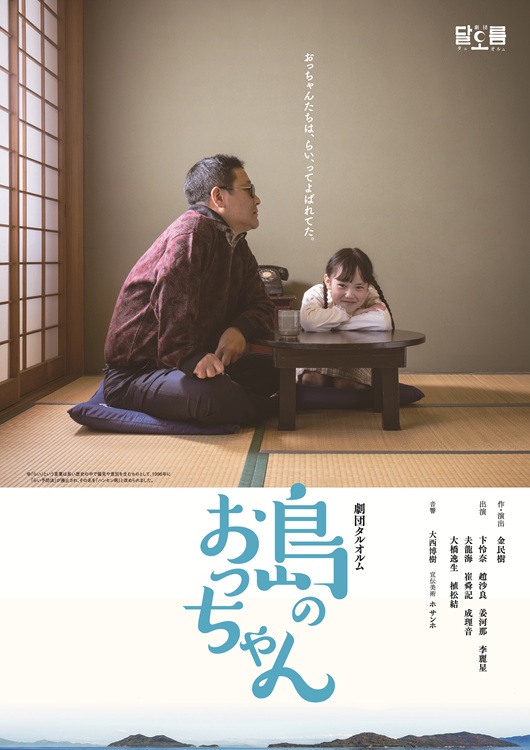
The play "The Old Man on the Island" is being performed.
*This event has ended.
Set in the Nagashima Aiseien Nagashima-Aiseien Leprosy sanatorium, the film depicts the reality of isolation, the connection between people, and the dignity of humanity through the story of a Korean resident of Japan who lived there and the young girl who interacted with him.
◆ Saturday, September 19, 2026 2 performances
①11:00-12:30 (doors open at 10:30)
②14:30-16:00 (doors open at 14:00)
◆ Tama Zenshoen Public Hall
(Please note that the venue is different from usual.)
◆ Capacity: 200 people per session. Advance registration required via the website.※Finished
Taruorum Theatre Company Profile
Founded in 2005 in Osaka by Zainichi Koreans and Japanese volunteers, the group was named Tal (moon) Oreum (rising) to evoke the image of moonlight illuminating the darkness. They have successively released works such as "The Day My Younger Brother Disappeared," "The Island Old Man," "Utoro," "Beyond That Gaze," "The Wind of 4.24," and "For the Flowers at the Edge of the World," and actively perform at Korean schools and Japanese schools throughout Japan. They mainly create works that trace the roots of Zainichi Koreans and works that incorporate songs and instruments from traditional culture. Please feel free to contact us for performance requests.
"Saihate no Toritachi (2022)" was selected as an outstanding work at the "1st Kansai Engeki Grand Prize".
"The Voice of the Wind," which was performed in Busan, won the "Notable Perspective" award at the 2023 Korean Red Awards.
HP: https://dal-o-reum.com/
E-mail: talorum2005@yahoo.co.jp
Lecture by Hiroshi Hoshina (with sign language interpretation)
Hansen's Disease Literature in Colonial Taiwan
*This event has ended.
This study focuses on Hansen's Disease literature in Taiwan during the Japanese colonial period, interpreting the experiences and thoughts of the writers. Through literary expression, it aims to deepen our understanding of Issues related to leprosy from multiple perspectives.
◆ October 25, 2026 (Sunday)
14:00-15:30 (doors open at 13:30)
◆ The National Hansen's Disease Museum Video Hall
◆ Capacity: 140 people. Advance registration required via the website.※Finished
Instructor Profile
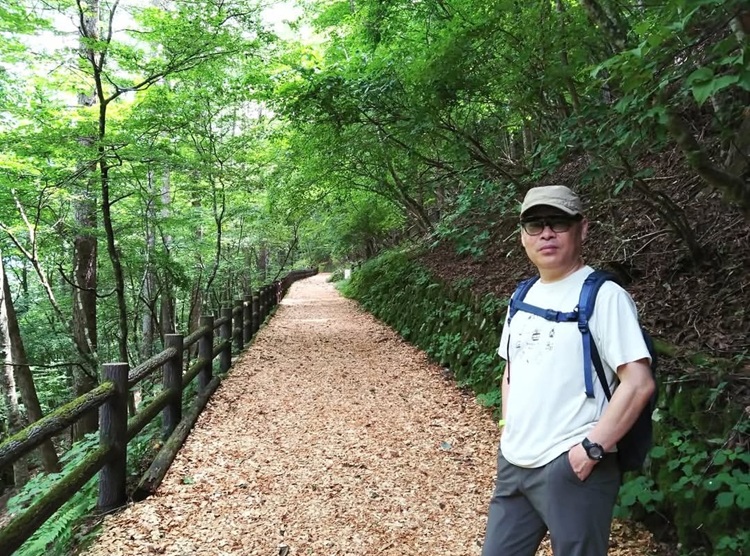
Hironobu Hoshina (Professor, Hitotsubashi University)
Specializing in Taiwanese literature during the Japanese colonial period, she has particularly focused on "unknown" writers who are not included in literary history. Recently, through her analysis of literature surrounding Hansen's Disease, she has been clarifying the relationship between state-sponsored isolation policies and literary expression. By focusing on the narratives of marginalized people, she presents a perspective for reconsidering Issues related to leprosy from a literary standpoint.
Acoustic guitar
Takashi Nakagawa's solo acoustic live performance
Takashi Nakagawa (Soul Flower Union) is a leading musician in the Japanese rock/soul scene. He has created works with powerful lyrics and diverse musical styles, addressing issues such as war, discrimination, earthquakes, and poverty. He has also visited disaster-stricken areas and other locations, engaging in solidarity through music. His activities are not merely musical expression but are highly regarded as an endeavor that questions society and connects people.
This event aims to be a forum for us to reflect together on issues of prejudice and exclusion in modern society, including Issues related to leprosy, through Mr. Nakagawa's acoustic performance.
◆ Saturday, November 14, 2026
15:00-16:00 (doors open at 14:30)
◆ The National Hansen's Disease Museum Video Hall
◆ Capacity: 140 people. Advance registration required via the website.
*All seats are now fully booked through advance reservations.
If there are any cancellations, same-day tickets will be distributed at the reception desk from 2 PM on the day of the event.
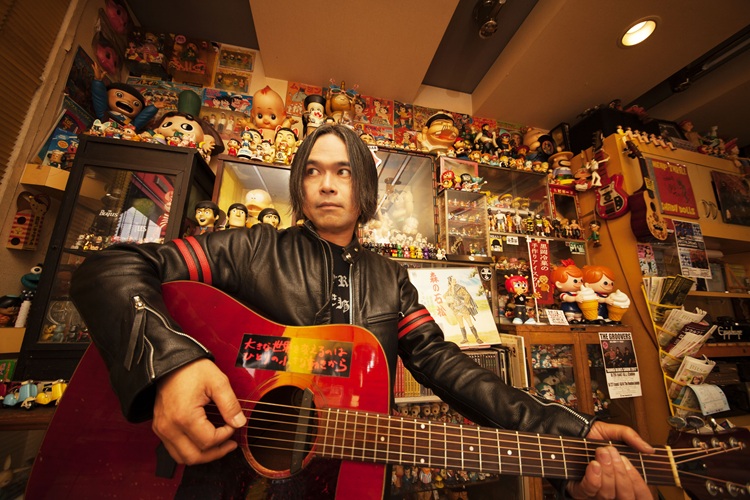
Profile of Takashi Nakagawa
He is the vocalist, guitarist, and sanshin player for the rock band "Soul Flower Union." Starting with his predecessor band "Newest Model," and continuing with his parallel activities "Soul Flower Mononoke Summit" and solo acoustic performances, he has captivated many people through his diverse activities, both in his music and live performances. He energetically incorporates and embodies all kinds of music, including traditional, soul, jazz, punk, reggae, Latin, folk, chindon, and rock and roll, and his talent for bringing together the musicality of these bands has earned him high praise as a songwriter and producer.
Furthermore, during the Great Hanshin-Awaji Earthquake, they performed over 200 live shows in evacuation centers, temporary housing, and reconstruction housing, using folk songs and pre-war popular songs as their repertoire. In the 2011 Great East Japan Earthquake, they performed about 30 live shows in evacuation centers and temporary housing throughout Tohoku. "Full Moon Evening" is a famous song that was created in February 1995 in an evacuation center in Kobe. They have also performed live shows in marginal locations around the world, such as East Timor, Palestinian refugee camps, and Smoky Mountain in the Philippines.
In 2015, he began touring nationwide with a full-fledged acoustic guitar performance. In December 2020, he released the album "Habitable Zone" with Soul Flower Union, and in 2023, he released his fifth solo album, "Melodious Night Train."
In 2026, Newest Model will celebrate their 40th anniversary and their 60th birthday, and they plan to hold commemorative live performances throughout Japan.
Screening of the film "The Island of the Great Wind"
Le Sheng Yuan, Taiwan's only Leprosy sanatorium.
A 20-year documentary about forced evictions.
Winner of the Grand Prix, Best Documentary Award, and Best Editing Award at the 27th Taipei Film Festival, and the Silver Award at the 32nd Taiwan International Women's Film Festival.
Director: Xu Yating
2025 Taiwan, Japan, France 120 minutes
◆ November 23, 2026 (Monday, holiday)
Screening from 13:00 to 15:00 (Doors open at 12:30)
3:00 PM - 3:30 PM: Stage greeting by director Xu Ya-ting
*Please note that the speakers may change due to unforeseen circumstances.
◆ The National Hansen's Disease Museum Video Hall
◆ Capacity: 140 people. Advance registration required via the website.
*All seats are now fully booked through advance reservations.
If there are any cancellations, same-day tickets will be distributed at the reception desk from 12:00 PM on the day of the event.
"The Island of the Great Wind" - Work Introduction
Lesheng Sanatorium, Taiwan's only public Leprosy sanatorium, is located on the outskirts of Taipei. Since 1930, during the Japanese colonial era, Leprosy patients have been forced to live in lifelong isolation. For a long time, their existence was overlooked, but 20 years ago, when the Taiwanese government sold the sanatorium's land to the Taipei MRT (subway) and attempted to forcibly relocate the residents, they have been fighting to protect their land. Lan Caiyun, who learned how to express her feelings through the movement and was elected as Resident Association. Huang Wen, who vividly recounts his powerful memories of standing up to the authorities with his physical disability and song. Huang Jinying, who supports the patients and takes care of the dogs and cats that have taken up residence at the sanatorium. The bravery, indomitable spirit, and kindness of these residents have sustained the struggle, which has grown into Taiwan's most influential grassroots democratization movement. However, as they grow older, the shadow of construction looms closer, and government repression intensifies. The residents face the threat of forced eviction, which destroys their homes, lives, and memories. Fighting against the threat of erasing a history of isolation and discrimination, they never give up. This film follows and observes the 20-year resistance of the fighting residents and the young supporters, including the director, who stand by them. Facing the inevitable worsening of after-effects, aging, and eventual separation, this is a record of people fighting to survive and resist being forgotten.
Japanese title: "Ōkaze no Shima" (The Island of the Great Wind)
Original title: Island of the Winds English title: Island of the Winds
Director: Xu Yating
Producers: Huang Yingyi, Xu Yating
Co-producers: Yuzhi Qin, Baptiste Brunner / Editor: Yuzhi Qin / Music: Wang Yujun
Produced by: Argosy Films and Media Productions, Kibayashi Films, Moorin Productions Co., Ltd., Wide Productions, Gurigura Films
2025 / Taiwan = Japan = France / 120 minutes / Taiwanese Mandarin, Taiwanese, Japanese / Documentary
©2025 Argosy Films and Media Productions, Moolin Films, Moolin Production, Wide Productions, Gurigura Films ALL Rights Reserved.
Distributed by: Pandora, Moulin Production
Prior to its theatrical release at Shibuya Eurospace in March 2027, the film will have its Japanese premiere at The National Hansen's Disease Museum on November 23rd.
Gallery talk by the curator in charge
Tetsuya Kimura, the curator in charge of this exhibition, will explain the meaning behind the exhibited materials and share anecdotes about the residents, deepening understanding of Issues related to leprosy.
2026
◆July 19th (Sun) ◆August 2nd (Sun)
◆Saturday, August 8th ◆Friday, August 14th
◆September 13th (Sun) ◆September 27th (Sun)
◆October 3rd (Sat) ◆October 17th (Sat)
◆November 22nd (Sunday) ◆November 28th (Saturday)
All from 14:00 (45 minutes)
◆ The National Hansen's Disease Museum Special Exhibition Room
◆Capacity: 30 people. No advance registration required.
Gallery talk for groups
A gallery talk will be held at the venue for groups of 10 to 30 people.
For applications, please contact the following:
◆Please apply at least one week before your desired visit date.
◆Please note that we may not be able to accommodate your preferred date, time, or content due to unforeseen circumstances.
<Contact information for group gallery talks>
Tetsuya Kimura (Curator), Projects Division The National Hansen's Disease Museum
Download the flyer here (PDF: 2.71 MB)