
Event details
- Top
- event information
- Event List
- [Lecture] What I want to tell those of you who want to become social workers
2018.12.23
[Lecture] What I want to convey to those who aim to become social workers
*Event has ended
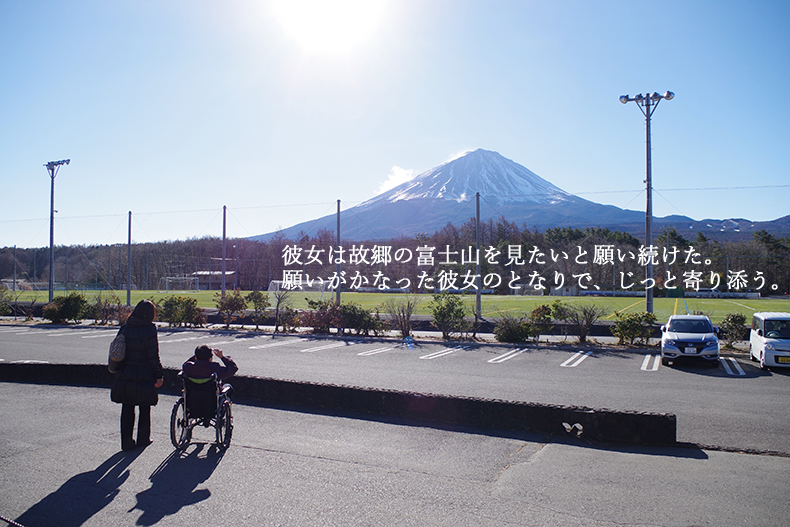
Leprosy sanatorium will talk about why he wanted to become a social worker, what makes his job worthwhile, and the difficulties that residents face.
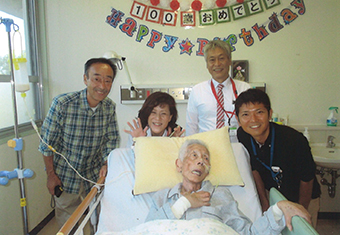 Resident's 100th birthday |
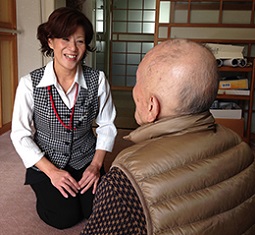 Talking with residents in their rooms |
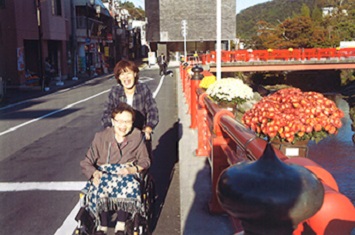 Homecoming |
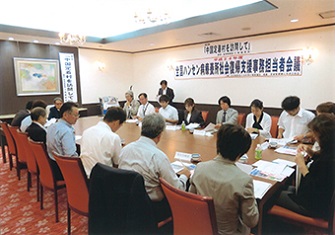 Scenes from the meeting |
Outline of the event
【Teacher】
Etsuko Sakate (Social Worker, Welfare Section, National Sanatorium Oku-Komyoen)
[Date and Time]
Saturday, December 22, 2018
[Opening]
14:00 (doors open at 13:30)
【place】
The National Hansen's Disease Museum Video Hall
[Capacity]
First 130 people
Free admission / No prior registration required
Lecture "What I want to tell you who are aiming to be social workers" Report
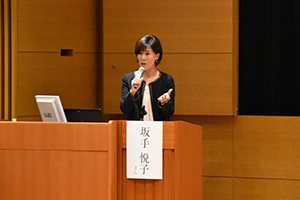
On Saturday, December 22, 2018, we held a lecture entitled "What I want to tell those of you who want to become social workers." The lecturer was Ms. Etsuko Sakate, a social worker working at National Sanatorium Oku-Komyoen. Ms. Sakate spoke for about an hour about her encounter with Issues related to leprosy, why she wanted to become a social worker and the path she took to achieve that goal, as well as the details of her daily work.
What particularly impressed me was the story about the relationship between residents and their families. Social workers at Leprosy sanatorium are responsible for contacting and coordinating with families, such as when a resident passes away. The relationships between residents and their families vary, but according to Sakate, there are still many cases where residents keep their family members secret, fearing that their family members or the public will find out about Leprosy patients. Of course, the reason for this is that prejudice and discrimination against Hansen's Disease are still deeply rooted, and I was reminded of this once again.
Also, at the end of the lecture, Sakate used the metaphor "seeing the forest for the trees" to explain the perspective required of social workers. The "trees" refer to the circumstances of each individual social worker, and the "forest" refers to the larger framework surrounding people with difficulties, including the state of politics and society. Social workers are expected to take both into account when providing support to people with difficulties. I felt like I got a glimpse of Sakate's pride and philosophy in the profession of social worker.
Approximately 70 guests gathered at the venue. As this was planned as a lecture for young people, there were a lot more young guests in attendance than at other events held by our museum.
We would like to express our sincere gratitude to all the guests who took the time to attend during this busy end-of-year period, and to Mr. Sakate for his valuable lecture.
We would like to introduce some of the opinions and feedback we have received from our customers.
- It was a great learning experience for me to learn about the work of social workers that I had never known before. The content was so real that I could talk only because Mr. Sakate, who knows the actual situation and the situation, and I was able to look at what I was doing. I had the experience of feeling discrimination and prejudice within myself, so I could somehow feel how I was involved (in welfare) and how I was looking at care and support. After attending this event, I thought I could think more about what would happen to me in the future.
- I am aiming to be a social worker, but I was not particularly interested in Hansen's Disease However, I think that approaching while respecting human rights, which supports "living with dignity," is the most important thing in the field of welfare and medical care. I thought that the perspective of looking at trees and the perspective of looking at forests are the same regardless of the target audience, as I interact with patients and users.
- I was able to spend a very meaningful time. Hansen's Disease was not only physical, but also mentally and socially, and it hurt the person and those around him, and I was surprised and distressed that it would continue.
- Through Mr. Sakate, I was able to hear the voices of the sanatoriums and had the opportunity to think about my family and society. I felt that it was necessary to keep an antenna on human rights and law, and that we should look not only at the micro level but also at the meso-macro range. I was able to learn about the work of social workers, which is different from normal work. There are many things about the end.
- Hansen's Disease to the present day in an easy-to-understand manner, including specific examples. I was able to hear a valuable story that people who first Issues related to leprosy
- Each story is deep, and all episodes are directly conveyed through Mr. Sakate's personality. I thought that "looking at the trees and looking at the forest" was a necessary perspective for any social problem.
- It is unbelievable that there is still Hansen's Disease Those who discriminate may be ignorant Hansen's Disease In that sense, Hansen's Disease Museum is of great significance. I just hope that prejudice and discrimination will be corrected as soon as possible. I realized again that the job of being a social worker who is close to Leprosy patients
We would like to continue to consider plans that many people can participate in, so we look forward to working with you.
Shunichiro Otaka Curator, Business Division, The National Hansen's Disease Museum
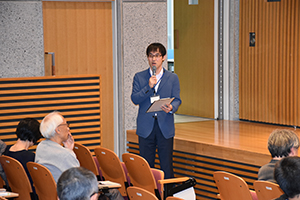 Opening remarks (Moderator: Curator Otaka) |
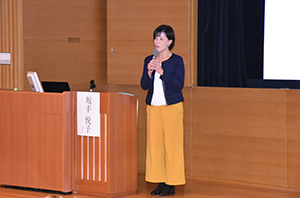 Greetings from the lecturer (Etsuko Sakate) |
 Scene from the lecture (Etsuko Sakate) |
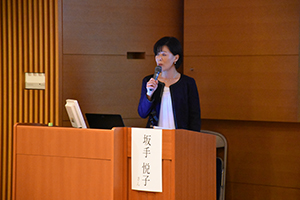 Scene from the lecture (Etsuko Sakate) |
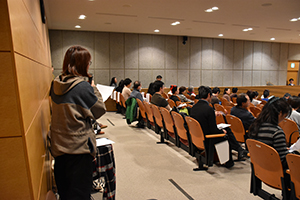 Q&A session |
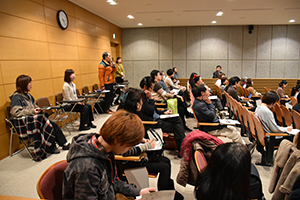 Q&A session |
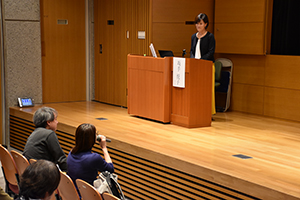 Q&A session |
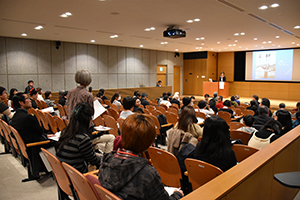 Q&A session |
 Q&A session |
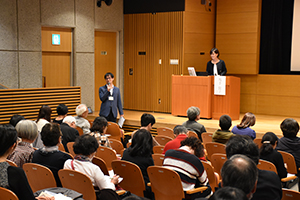 Closing Remarks (Curator Otaka) |