
Event details
- Top
- event information
- Event List
- [2012 Spring Exhibition] Young People's "Reintegration into Society" - 1950-1970
2012.08.01
Information on the 2012 Spring Exhibition
*Event has ended
Young People's "Reintegration into Society" - 1950-1970
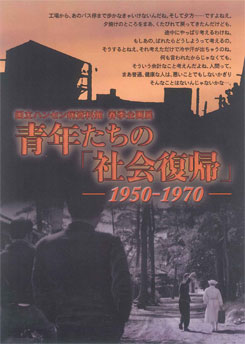
In today's Japan, it is rare for young people to develop Hansen's Disease. However, in the past, those who contracted the disease at a young age and were isolated suffered from the feeling of resignation that they had no choice but to live in a sanatorium, and the emptiness of wondering if they too would soon become like the long-term patients in front of them.
Chemotherapy drugs, which appeared in the late 1940s, changed the conventional idea that people would end their lives in a sanatorium. If they were cured, they could lead a life as a member of society, have a home, give birth to and raise children, and live with their families - this was no longer a dream. Leprosy Prevention Law had no provisions for leaving the sanatorium, so young people who had been cured and whose after-effects were mild left the sanatoriums for "long-term visits home", "temporary leave", or even "running away". This "reintegration into society" reached its peak in 1960 (Showa 35) against the backdrop of rapid economic growth.
However, this also meant that young people in sanatoriums after the war were forced to choose between living under isolation, where their livelihood was guaranteed even if they were poor, or "reintegrating into society" despite the various obstacles. For those who were isolated and lost all the bases of life, such as jobs and families, it was extremely difficult to return to society. Furthermore, even though they were forced to enter the sanatoriums under the isolation policy, there was almost no support, such as job placement or financial support until they found work. Some people who left the sanatoriums once were exhausted by the harsh struggle for survival and re-entered the sanatoriums.
Outside the sanatorium, the fact that Hansen's Disease could be cured was not even known. In an environment of intense prejudice that is incomparable to today, the people had to continue to hide their history as Hansen's Disease, and were constantly subjected to hard labor and the fear of relapse. "Reintegration into society" at the time meant embracing the pain of being tormented by feelings of "regret" and "pity" due to their untold past and aftereffects, as well as the joy of living for themselves.
This exhibition introduces the discussions and movements regarding "social reintegration" from around 1950 to 1970, and conveys some of the difficulties and challenges faced by young Former leprosy patients through the portrayals of people who experienced "social reintegration" at that time. In addition to the "suffering of living in sanatoriums," which has been the main focus of attention surrounding Hansen's Disease, the exhibition also focuses on the "suffering of living out in society," and aims to once again question the nature of discrimination and prejudice that lurks within us.
Outline of the event
[Date]
April 28, 2012(soil)From July 29th(Day)
【venue】
The National Hansen's Disease Museum 2nd floor Special Exhibition Room
【closing day】
Admission is free on Mondays (or the following day if Monday is a public holiday) and on cleaning days.
Exhibition Explanation
A curator will provide an explanation of the exhibits.
[Date and Time]
Third Saturday of each month (May 19th, June 16th, July 21st) from 14:00 for about 40 minutes